Texarkana's Wildest Radio Station!
Texarkana's Wildest Radio Station!
August 2, 2026
TEXARKANA, Texas — A long list of manufactured THC products became controlled substances in Texas on Friday, and the rules now differ sharply depending on which side of State Line Avenue you are standing on.
This story is general information, not legal advice. Anyone with a specific question should consult an attorney.
What changed in Texas
Effective July 31, the Texas Department of State Health Services reinstated its 2021 definitions of "tetrahydrocannabinols" and "marihuana extract" in the state's controlled substance schedules. The reinstated definition reaches THC compounds other than delta-9, including isomers and variants.
In practice, that covers delta-8, delta-10, THC-O, HHC, THCP and similar manufactured or converted cannabinoids. Because retail delta-8 is chemically converted from CBD rather than naturally present in hemp, the state treats it as scheduled.
The change did not come from the Legislature. DSHS adopted the definitions in 2021, a Travis County court blocked them, and the Texas Supreme Court lifted that injunction on May 1 in Sky Marketing Corp. v. DSHS. The agency published notice in the July 10 Texas Register that the definitions would take effect July 31.
The penalties are more serious than the headlines suggest
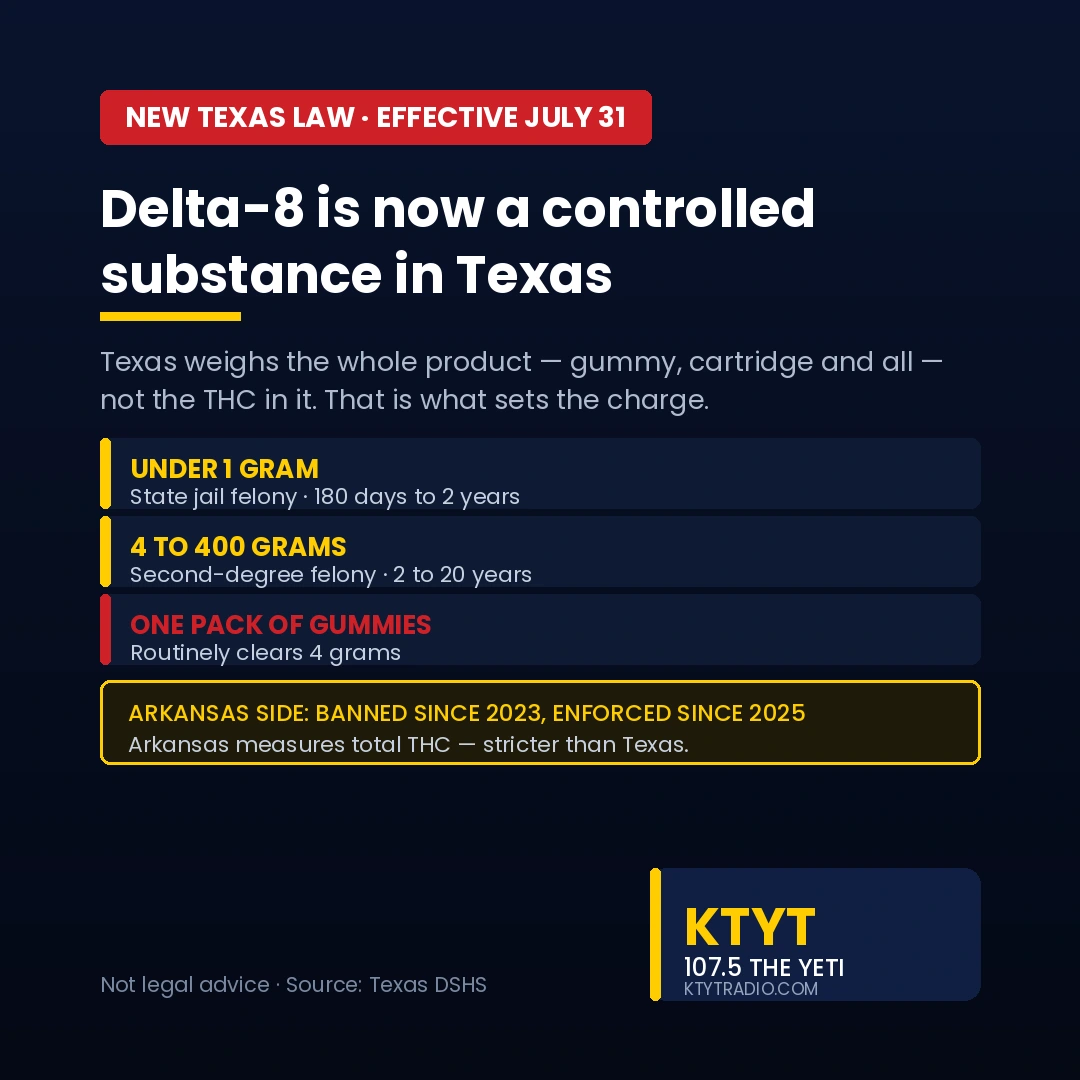
THC concentrates, vape cartridges and edibles are not treated as marijuana under Texas law. They fall under Penalty Group 2, and there is no misdemeanor level.
Critically, Texas grades these offenses by the aggregate weight of the product including adulterants and dilutants. The state weighs the entire gummy, the entire cartridge, the whole brownie — not the THC inside it.
— Under 1 gram: state jail felony, 180 days to two years
— 1 gram to under 4 grams: third-degree felony, two to 10 years
— 4 grams to under 400 grams: second-degree felony, two to 20 years
— 400 grams or more: first-degree felony, five to 99 years or life
A single vape cartridge can weigh one to two grams. A package of gummies routinely exceeds four grams. That means a quantity most people would consider personal use can carry a second-degree felony range.
What is still legal in Texas
Hemp products containing no more than 0.3% delta-9 THC by dry weight remain legal, along with CBD, CBG and CBN. Retail sales are restricted to buyers 21 and older. That covers most compliant delta-9 edibles, drinks and tinctures on store shelves.
What did not change
Marijuana. The possession statute was untouched. Two ounces or less remains a Class B misdemeanor in Texas.
What is unresolved
Smokable hemp flower is the subject of separate litigation that has not been decided. A Travis County judge issued a temporary injunction on May 1 blocking a separate set of DSHS rules that would have banned it.
The Arkansas side is different, and has been for a year
None of this is new in Arkansas. Act 629 of 2023 classified delta-8, delta-10 and similar converted cannabinoids as Schedule VI controlled substances. A federal injunction paused it until the Eighth Circuit reversed that injunction in Bio Gen v. Sanders on June 24, 2025, and enforcement began the following month. Act 934 of 2025 expanded the framework to measure total THC.
Arkansas also measures differently. The state calculates total THC as THCA multiplied by 0.877, plus delta-9 THC. A product that satisfies the federal 0.3% delta-9 standard can still fall outside Arkansas law.
For a city divided by a state line, that matters. A product purchased legally at a Texas-side retailer may not be legal to possess on the Arkansas side.
Enforcement
DSHS scheduling establishes what is controlled. Criminal charges are brought by county prosecutors and local law enforcement, and charging practices can vary between jurisdictions.
Residents with questions about a specific product should consult an attorney rather than relying on how a product is labeled or where it was purchased.